Why Industry-Specific Booking Software Beats Generic Scheduling Tools for Service Businesses
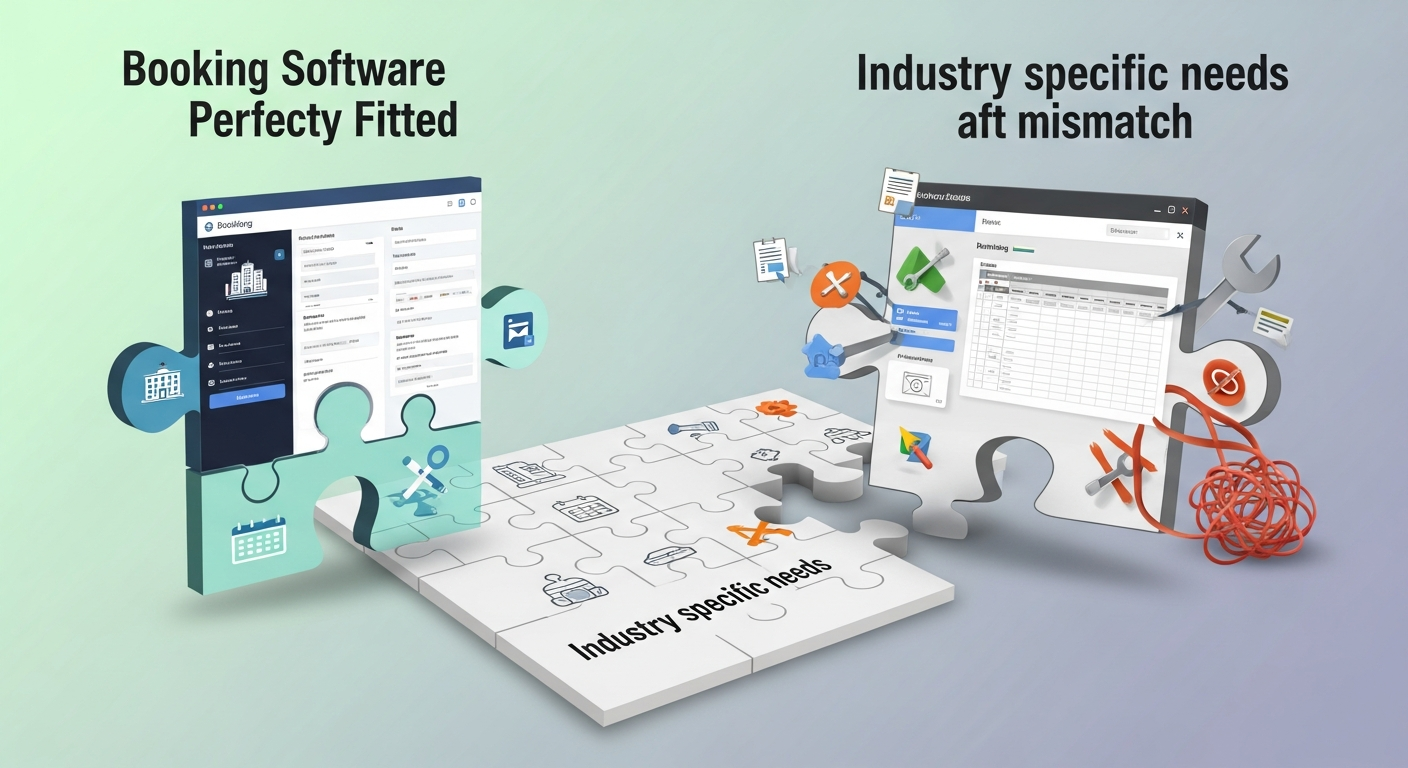
There's a reason the best software in every category is purpose-built rather than generic. A generic project management tool does many things passably; a construction-specific PM tool does the things construction companies actually need — subcontractor management, material tracking, permit workflows — excellently.
The same principle applies to booking software. Generic scheduling tools (Calendly, Google Calendar appointments, HubSpot Meetings) handle the common case: two people finding a mutually available time. Service businesses need everything beyond that.
What Generic Tools Miss About Service Business Operations
Revenue-per-appointment model: Generic schedulers assume meetings are free. Service appointments generate revenue. The entire architecture of payment, deposits, and no-show protection is built around this fundamental difference.
Service menus with variable pricing: You don't have one "meeting type" — you have 5 to 15 different services, each with different durations, prices, and preparation requirements. Generic tools force you into uniform meeting types.
Buffer time per service: A 90-minute color treatment needs different transition time than a 20-minute trim. Generic tools apply one buffer to all event types.
Cancellation policy enforcement: Corporate meetings that get cancelled don't cost money. Service appointments do. Automated enforcement of a financial cancellation policy is a service-business-specific need.
Marketplace discovery: Executives don't search a marketplace to find an available sales rep. Consumers search marketplaces to find service providers. Marketplace listing is a service-business-specific feature.
The Generic Tool Workaround Tax
Every hour you spend working around a generic tool's limitations is an hour you're paying twice: once in time, once in opportunity cost. Common workarounds include:
— Sending a separate payment link after Calendly booking (manual step, high drop-off) — Managing a deposit spreadsheet alongside your booking calendar — Manually texting reminder messages to clients — Calling clients who missed appointments to negotiate the cancellation fee — Running a separate waitlist through Instagram DMs
All of these workarounds disappear with purpose-built booking software.
Read more: mybokr.com/blog/automated-appointment-reminders-reduce-no-shows Read more: mybokr.com/blog/how-to-manage-waitlist-fully-booked-business
MyBokr's Industry-Specific Architecture
MyBokr (mybokr.com) was built for one type of business: service providers who earn revenue through appointments. Every feature — per-service pricing, deposit configuration, buffer time, waitlist, marketplace listing, post-appointment follow-up — exists because service businesses need it specifically.
There's no feature bloat from corporate meeting scheduling. No adapting meeting-scheduler logic to fit a service business. Just a clean, purpose-built platform.
Read more: mybokr.com/blog/best-online-booking-software-small-business-2025
Stop Working Around Your Tools
Get a booking platform built for the way your service business actually works at mybokr.com.